From 3D Scan to a Storage System: The Wheels & Feels Journey
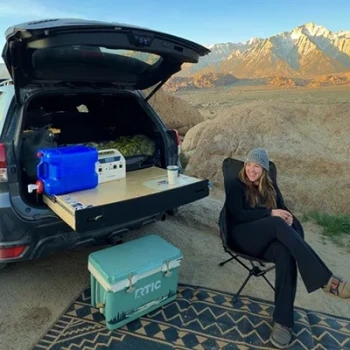
Wheels & Feels develops custom storage systems and camping solutions for vehicles, based on precise 3D scanning, engineering adaptation for specific models, and practical user feedback.
Rob, VP of Operations at Wheels & Feels, talks about the company’s development processes, production, and future.
He describes the product journey in detail, from the first vehicle measurements to a finished storage system. According to him, everything starts with a “raw” vehicle, which is scanned using the Clarity laser system. This makes it possible to capture a complete digital outline of the vehicle, including all mounting points where the storage system will later be installed.
Based on this scan, a project is created that becomes the foundation for custom development for a specific vehicle model. After that, the team moves into the design stage and then into production.
After the first prototype is made, it goes through testing to check whether it can be correctly assembled and installed in the vehicle. Only after that are workflows, instructions, and training developed for further production scaling.
Speaking about adapting designs for different SUV models, Rob notes that the company mainly works with custom solutions. Each system is created based on the exact geometry of a specific vehicle obtained through scanning. In parallel, the company works with manufacturers on types of mounting systems.
At the same time, Wheels & Feels is already developing universal solutions, however most of the products remain custom-made for specific vehicles.
Prototyping in the company is directly driven by customer demand. Demand shapes the selection of vehicles that are then scanned and become the basis for new developments. Based on this data, prototypes of future systems are created.
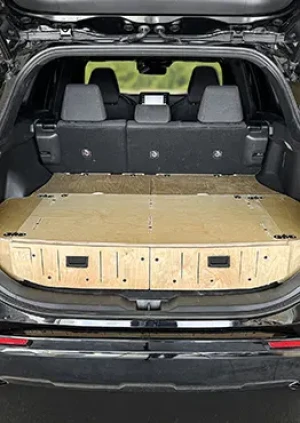
Birch UV plywood is used in production, selected with engineering loads and machining precision requirements in mind. According to Rob, this material provides an optimal balance of strength, weight, and cutting quality.
Metal rails are also used, designed to handle loads of up to 250 pounds. In the future, the company plans to expand its range of materials.
Special attention is given to testing. After the system is installed in a vehicle, most often under real use conditions, for example in a Jeep, the company receives feedback within the first month. At this stage, potential issues such as vibrations or rattling are identified. In such cases, the design is refined, and additional screws and mounting points are added. This process allows the product to be improved before mass production.
Wheels & Feels positions itself as an environmentally responsible company. All materials used are recyclable, and production waste is properly disposed of. In the long term, the company plans to fully transition to environmentally sustainable materials.
Rob also highlights the role of artificial intelligence in the company. AI is already used to calculate system dimensions and parameters, as well as to quickly process customer requests. At the moment, the technology is applied at the customer service level, but in the future it is expected to be integrated into engineering processes as well. At the same time, human expertise remains a key element of development.
In customer relations, the company uses a combination of automated responses and live communication. Despite the introduction of AI, the support team continues to play an important role in user communication.
As for logistics, expedited shipping is offered as a priority system. If a customer has a trip planned, their order can be moved higher in the production queue, which helps reduce lead times.
The main limitation in production at the moment remains material supply. Despite the availability of alternative suppliers, logistical challenges and tariff factors continue to affect timelines.
Speaking about the company’s future, Rob emphasizes the goal of significantly reducing production and delivery times. In the long term, standard models are planned to be kept in stock to ensure shipping within approximately one week. To achieve this, the company is already expanding production and introducing new equipment, increasing output and speeding up internal processes.
We invite you to watch the full interview with Rob, where he shares how the company operates and what drives its development.